Queue Management System in Saudi Arabia: 2026 Buyer’s Guide
Long waiting lines quietly drain revenue, frustrate shoppers, and damage brand trust. A modern queue management system in Saudi Arabia turns that chaos into measurable, orderly customer flow. As Vision 2030 pushes retail, banking, and government services toward world-class experiences, smart queuing has shifted from a nice-to-have to a core operational tool in 2026.
This guide breaks down how these systems work, what features matter, and how to choose a platform that pays for itself. Whether you run a bank branch in Riyadh or a clinic in Jeddah, the right setup cuts wait times and lifts satisfaction.
Why a Queue Management System in Saudi Arabia Matters in 2026
Saudi consumers expect speed. Research from McKinsey & Company shows that reducing perceived wait time is one of the strongest drivers of service satisfaction across sectors. When people feel their time is respected, loyalty follows.
Digital queuing replaces physical lines with tickets, mobile check-ins, and real-time displays. Customers relax, staff stay focused, and managers finally see the data behind every counter.
- Shorter waits: smart routing sends customers to the first available agent.
- Happier staff: balanced workloads reduce burnout and errors.
- Actionable data: dashboards reveal peak hours and bottlenecks.
- Arabic + English: bilingual interfaces suit the local market.
For venues that also serve customers in their vehicles, pairing in-branch queuing with a PAR Drive Thru in Saudi Arabia setup extends that same flow intelligence to the lane outside.
Core Features of a Modern Queuing Platform
Not every solution is equal. Before you sign a contract, confirm the platform covers the essentials below. The best vendors, such as these dependable specialists, bundle hardware, software, and support into one accountable package.
Must-Have Capabilities
- Virtual and ticket-based queuing for both walk-ins and mobile bookings.
- Digital signage that calls numbers on large displays with audio.
- SMS and app notifications so customers wait anywhere.
- Appointment scheduling integrated with the live queue.
- Analytics and reporting exported to your BI tools.
How Does a Queue Management System Actually Work?
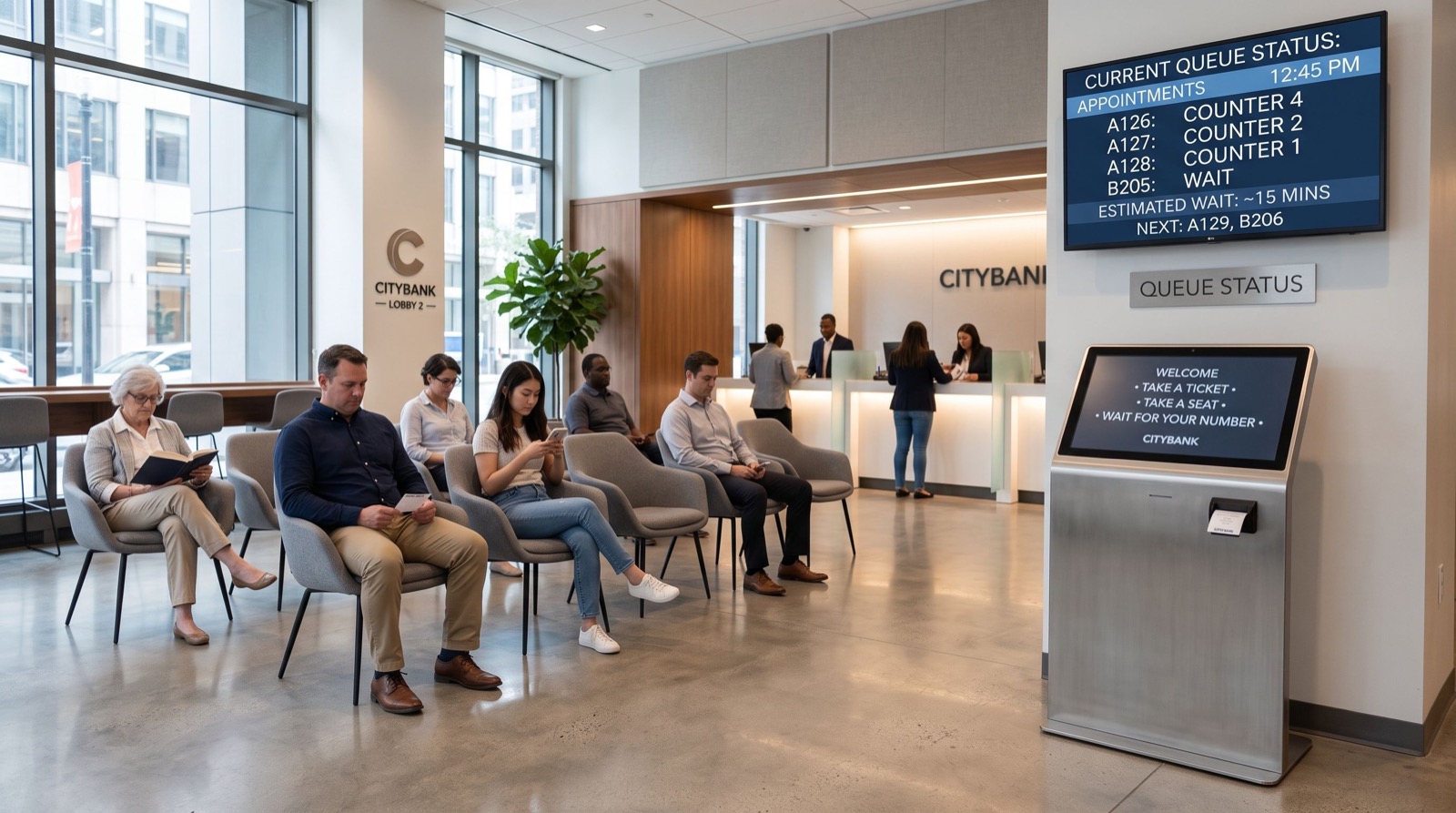
The workflow is simple on the surface but powerful underneath. A customer arrives, selects a service on a kiosk or phone, and receives a ticket. The system then routes that ticket based on priority, agent skill, and current load.
Behind the scenes, algorithms track every second. Managers watch a live dashboard, reassign staff instantly, and receive alerts when a counter falls behind. This closed loop is what separates a basic ticket printer from a true queue management system in Saudi Arabia built for 2026 demand.
Comparing Deployment Options
Businesses usually choose between on-premise, cloud, or hybrid models. The table below summarizes the trade-offs so you can match the choice to your IT policy and budget.
| Model | Best For | Setup Cost | Scalability |
|---|---|---|---|
| Cloud | Multi-branch chains | Low | Excellent |
| On-premise | Strict data policies | High | Moderate |
| Hybrid | Banks & government | Medium | High |
Cloud platforms dominate new deployments in 2026 because they roll out across branches fast and update automatically. Regulated sectors still prefer hybrid setups that keep sensitive data in-country.
Industries Winning With Smart Queuing
Adoption spans nearly every customer-facing field in the Kingdom. Each sector tunes the system to its unique flow.
- Banking: separate lanes for teller, advisory, and VIP clients.
- Healthcare: patient triage with priority for emergencies.
- Retail: service desks and click-and-collect counters.
- Government: high-volume service halls under Vision 2030 reforms.
- Telecom: device setup, billing, and support stations.
In telecom stores especially, where setup and support visits overlap, queuing keeps technical staff productive and customers informed about realistic wait times.
Choosing the Right Partner
Technology is only half the equation. Implementation, training, and local support decide long-term success. Look for a provider with proven Saudi deployments, Arabic-language support, and a clear service-level agreement.
Request a live demo with your real peak-hour numbers. A credible vendor will show how a queue management system in saudi arabia handles your busiest moments without crashing or confusing customers. Ask about integration with your CRM, ERP, and existing signage before committing.
Questions to Ask Every Vendor
- How many counters and branches can one license cover?
- Is the interface fully bilingual and accessibility compliant?
- What uptime guarantee and on-site response time apply?
- Can analytics export to our existing reporting stack?
Measuring ROI
A good system proves its value within months. Track these metrics before and after rollout to quantify the gain:
- Average and maximum wait time per service.
- Abandonment rate (customers who leave the line).
- Staff utilization during peak versus off-peak hours.
- Customer satisfaction scores collected at exit.
Most Saudi branches report double-digit drops in abandonment once live tracking replaces guesswork. That alone often covers the subscription cost.
Frequently Asked Questions
How much does a queue management system in Saudi Arabia cost?
Pricing depends on branches, counters, and features. Cloud plans start low per month, while enterprise on-premise builds carry higher upfront hardware costs. Most vendors offer tiered packages so you scale as you grow.
Can it integrate with mobile apps?
Yes. Modern platforms let customers take a virtual ticket from a smartphone, receive SMS alerts, and arrive only when their turn nears. This remote queuing has become standard in 2026.
Is it suitable for small businesses?
Absolutely. Cloud-based, per-counter pricing makes smart queuing affordable even for a single clinic or boutique branch, with room to expand later.
Does it support Arabic?
Leading systems ship with full Arabic and English interfaces, bilingual signage, and right-to-left text support tailored to the Saudi market.
Common Mistakes to Avoid
Even great technology fails when rolled out carelessly. Across Saudi deployments, the same avoidable errors appear again and again. Steer clear of these traps and your project will land far more smoothly.
- Skipping the baseline: without before-and-after data, you cannot prove the value to leadership or justify expansion.
- Ignoring staff training: counter teams who do not trust the system will bypass it, and the data turns unreliable overnight.
- Over-complicating service menus: too many kiosk options confuse customers and slow the very flow you aim to speed up.
- Forgetting Arabic-first design: interfaces that treat Arabic as an afterthought frustrate a large share of users.
- Neglecting signage placement: displays customers cannot see or hear defeat the purpose of digital calling.
A seasoned vendor will flag these during the design phase, not after go-live. Insist on a walkthrough of your floor plan and peak-hour scenarios before any hardware is installed.
Trends Shaping Queuing in 2026
The technology keeps evolving. Three shifts stand out this year and are worth building into your buying decision.
- AI-driven forecasting: systems now predict rush periods from historical patterns and auto-suggest staffing levels before the crowd arrives.
- Fully contactless journeys: QR check-in, mobile tickets, and digital payments remove shared touchpoints entirely.
- Unified omnichannel flow: branches, call centers, and drive-up lanes increasingly share one customer-flow dashboard.
Choosing a platform that already supports these capabilities protects your investment and keeps your branches competitive as expectations rise.
Final Thoughts
A well-chosen queue management system in Saudi Arabia transforms waiting from a liability into a controlled, data-rich experience. In 2026, with customer expectations higher than ever, orderly flow is a genuine competitive edge. Map your peak-hour pain points, shortlist vendors with local proof, and demand a demo on real numbers. The right partner will shorten lines, lift satisfaction, and give you the insight to keep improving.