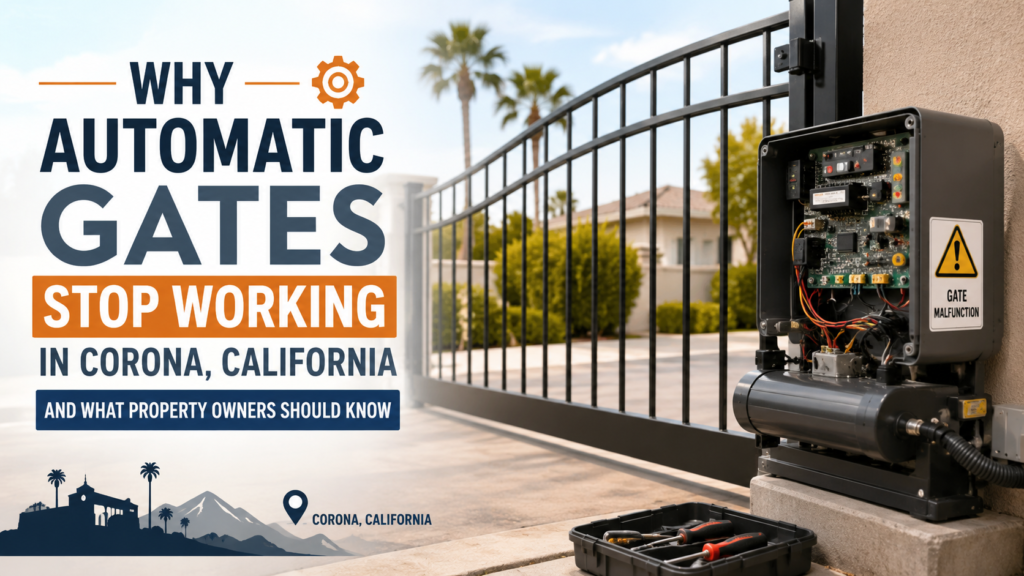
Automatic Gates Service Corona are one of the most valued features on residential and commercial properties throughout Corona, California providing security, privacy, and curb appeal in equal measure. But automatic gate systems are also among the most maintenance-intensive property features: they combine mechanical, electrical, and electronic components that are exposed to outdoor conditions 365 days per year, subject to daily operation cycles, and dependent on multiple subsystems working in coordination. When an automatic gate stops working in Corona, the cause can range from a dead battery in a remote control to a failed circuit board, and the appropriate response depends entirely on an accurate diagnosis of the problem. Understanding the most common reasons automatic gates fail in the Inland Empire helps property owners respond intelligently and know when to call for professional service.
The Most Common Reasons Automatic Gates Fail
- Dead or depleted batteries: The simplest and most frequently overlooked cause of gate failure. Remote controls use batteries that deplete over time. Solar-powered gate operator systems depend on battery banks that store solar energy if the battery bank is not maintained or has been shaded from sunlight for extended periods, the gate may simply lack stored energy to operate. Checking and replacing batteries is always the first diagnostic step before assuming a more serious problem.
- Electrical supply issues: Hardwired gate operators require a dedicated electrical circuit. Tripped circuit breakers, blown fuses in the operator, faulty GFCI outlets, or power outages affecting the gate circuit will all prevent operation. Verifying that the electrical supply is intact and that circuit breakers have not tripped is a basic diagnostic step for any gate that has suddenly stopped working.
- Obstruction sensors and safety loops: Professional gate installations include safety features that prevent the gate from closing on obstructions typically photo-eye sensors across the gate opening and/or vehicle loop detectors embedded in the driveway. If these sensors detect an obstruction (even debris, leaves, or insects that have accumulated on the sensor lens), or if a loop detector has been damaged (by digging, frost heave, or equipment), the gate system may refuse to close as a safety precaution. A gate that opens but will not close is a common presentation of a triggered obstruction sensor.
- Remote control or keypad programming issues: Gate operators store programmed code sequences for their remotes and keypads. Power surges, dead backup batteries in the operator, or accidental button sequences can clear or corrupt programming. A gate that does not respond to any remote but works from a hardwired button at the operator may have lost its remote programming.
- Mechanical wear and component failure: Gate operators include motor assemblies, gearboxes, drive chains or arms, and limit switches. After years of operation particularly in Corona Inland Empire climate where the operator is exposed to heat exceeding 100°F in summer these mechanical components wear, seize, or fail. Grinding noises, gates that operate sluggishly, or gates that stop before reaching the open or closed position are common symptoms of mechanical wear.
- Corrosion and environmental damage: The Inland Empire receives enough seasonal moisture particularly during Southern California winter rain events to create corrosion issues in gate operator components, particularly in older or lower-quality installations. Corroded control board connections, oxidized limit switch contacts, and seized mechanical linkages are all failure modes accelerated by the combination of ambient humidity, occasional rain, and the extreme heat cycles of Riverside County summers.
Corona Specific Climate Factors in Gate Failures
Corona Inland Empire climate creates specific gate maintenance challenges that differ from coastal Southern California communities. The combination of hot, dry summers with temperatures regularly exceeding 100°F and pavement surface temperatures significantly higher and the modest seasonal moisture of Southern California winters creates an environment where:
- Solar-powered gate systems must have their panels oriented and kept clean to maintain adequate charge. Accumulated dust and grime common in the dry Inland Empire summer reduce panel efficiency significantly.
- Rubber and plastic components in gate operators, including wiring insulation, gaskets, and drive belts, experience accelerated degradation from prolonged heat exposure. Gate operators installed in direct, unshaded sun exposure in Corona have shorter service lives for rubber and plastic components than those in shaded or cooler locations.
- Lubricant degradation is accelerated in extreme heat. Gate hinges, pivot points, and drive system components require more frequent relubrication in Corona high-temperature environment than in milder climates.
When to Call for Professional Gate Service
Some gate problems depleted remote batteries, a tripped circuit breaker, a leaf on a sensor lens are entirely within a property owner ability to diagnose and resolve. Others require professional service. Professional gate technicians should be called when:
- The operator is making unusual grinding, clicking, or straining sounds that suggest mechanical component failure.
- The gate has been struck by a vehicle and the structural alignment of the gate, hinges, or operator mounting has been affected.
- Electrical diagnostics are needed beyond checking the circuit breaker control board testing, wiring diagnosis, or capacitor replacement require qualified technicians.
- The gate operates but is consistently out of limit opening or closing too far or stopping short of fully open or closed indicating limit switch adjustment or replacement is needed.
- The operator is more than 10 to 15 years old and has had multiple component failures at some point, continued repair of an aging system is less economical than replacement with a modern, more reliable operator.
Preventive Maintenance for Corona Automatic Gates
Property owners in Corona can extend the reliable service life of their automatic gate systems through basic preventive maintenance: lubricating hinges and mechanical pivot points with appropriate outdoor-rated grease annually; cleaning solar panel surfaces regularly to maintain charging efficiency; testing safety sensors by passing an object through the gate opening during closure; checking remote control battery strength; and scheduling a professional inspection every 12 to 24 months to evaluate the operator, control board, wiring, and mechanical components before they fail.
Conclusion
Automatic gates in Corona stop working for a range of reasons from the trivially simple to the genuinely complex and diagnosing the actual cause determines whether the solution is a fresh battery or a professional service call. Understanding the most common failure modes, how Corona Inland Empire climate accelerates specific degradation patterns, and what maintenance practices extend reliable operation gives Corona property owners the knowledge to respond confidently and cost-effectively when their gate stops working.